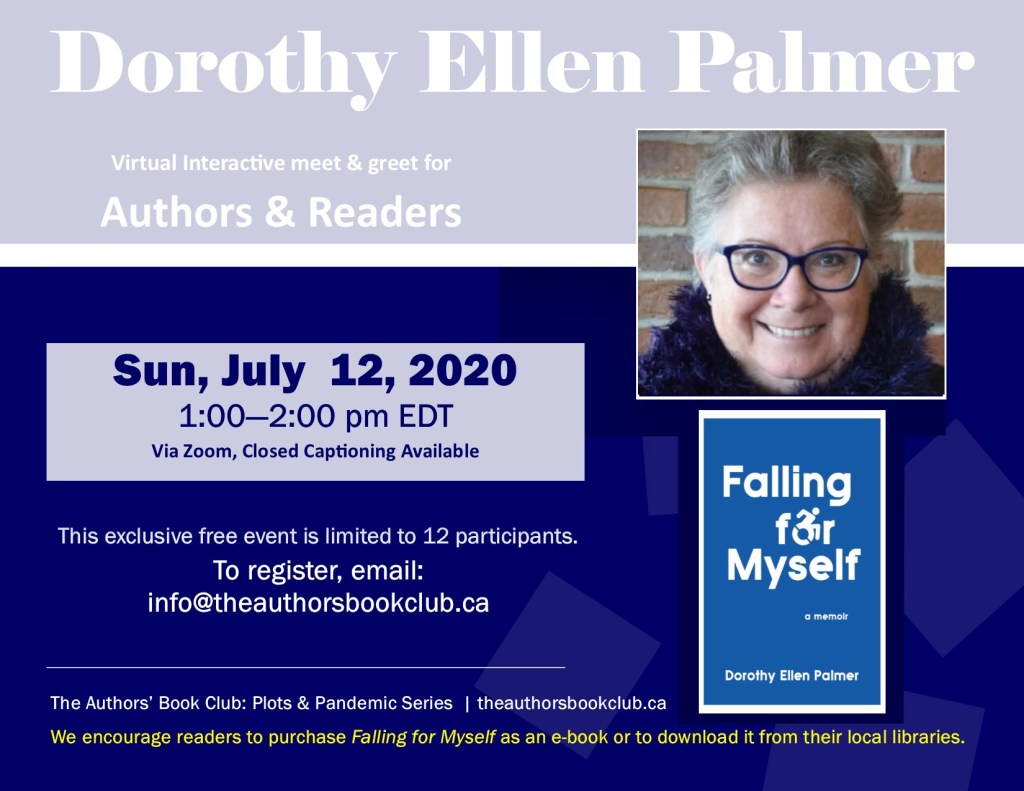
We are thrilled to host our next Plots & Pandemic Series event! Join us on Sunday, July 12, 2020, 1:00 – 2:00 p.m. EDT. Guests can interact with Dorothy and with each other. We will begin with a short reading followed by a group discussion and Q & A.
Register for this exclusive free event by emailing us at info@theauthorsbookclub.ca. Spacing is limited to 12 guests.
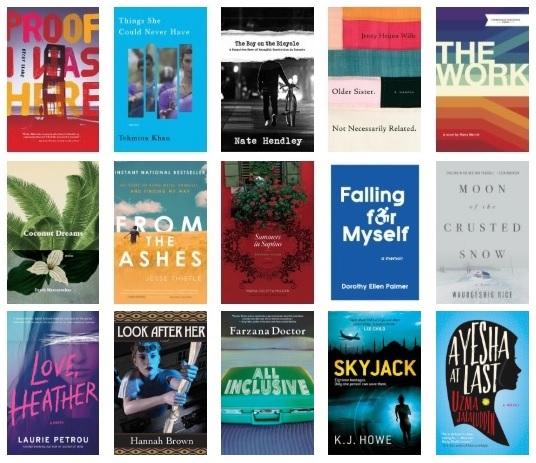
Dorothy is a mom, disabled senior writer, accessibility advocate, adoptee, retired high school Drama teacher, improv coach and union activist. Her recent memoir, Falling for Myself, (Wolsak and Wynn 2019) examines how disability and adoption combined to help her become an activist and find her birthparents. Reviewed in the Toronto Star, The Globe and Mail, and Quill and Quire, it has been heralded as both funny and whip smart. Her first novel, When Fenelon Falls, (Coach House, 2010), features a disabled teen protagonist in the Woodstock-Moonwalk summer of 1969. Her fiction and nonfiction has appeared in both literary and disability journals: REFUSE, Readers Digest, Broadview Magazine, Wordgathering, Canthius, Alt-Minds, All Lit Up, Little Fiction Big Truths, 49th Shelf, and Open Book. She serves on the Accessibility Advisory Committee for FOLD and the Disability Justice Network of Ontario (DJNO). She is a graduate of Western University and did her teacher training at Simon Fraser University.
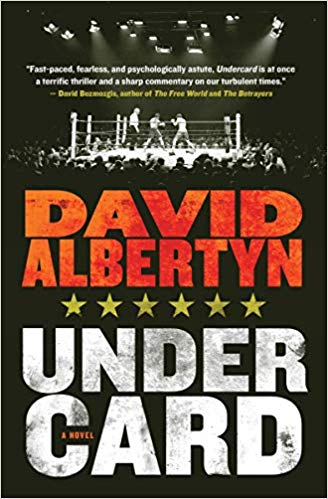
We’re delighted to kick off our Plots & Pandemic Series with our co-founder David Albertyn. Join us on Saturday, June 20, 2020 to engage in a virtual face-to-face event where guests can interact with David and each other. We will begin with a short reading followed by a group discussion and Q & A.
Register for this exclusive free event by emailing us at info@theauthorsbookclub.ca. Spacing is limited to 12 guests.
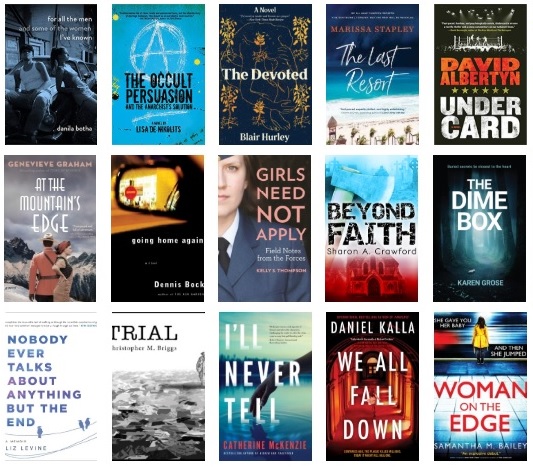
Born in Durban, South Africa in 1983, David immigrated to Toronto, Canada in 1993. A graduate of Queen’s University and the Humber School for Writers – where he received a Letter of Distinction – he has been writing stories since the age of six. A tennis coach who has competed extensively in both tennis and track and field, David’s goal is to write visceral novels that are both thrilling and meaningful. The result of all David’s interests, influences and efforts is Undercard (2019), which is infused with scrupulous research and the pulse of the times we live in. It immediately resonated with David’s Canadian publisher, House of Anansi, and went on to resonate with his international publishers, HarperCollins Germany and HarperCollins France, his World English audiobook publisher, Dreamscape Media, and the award-winning production company that optioned the film/TV rights, Shaftesbury.
As an author, I’ve had the pleasure of being invited as a guest to a number of book clubs, in person and online. Each time has been an absolute pleasure, and what struck me the most was the camaraderie amongst the members, so much so that I decided to start my own book club earlier this year.
Enter the COVID-19 pandemic and social distancing measures, which means in-person book club meetings must be postponed, and it might seem crazy to even think of starting a new club. Except we need human connections and something to look forward to more than ever right now, and a virtual book club could add to the comfort we so desperately need. The solution? A virtual book club. Here are some tips to get you started:
Find members
You can’t have a book club without members but where to find them? I posted in a local Facebook mom’s group and was immediately inundated with replies. Expecting a handful of participants, I couldn’t believe it when over 60 women indicated their interest. That number settled at 17 members after people couldn’t make it because of family and/or scheduling conflicts. 17 is quite a large number for a virtual book club, and I’d suggest having around 10 members so it’s easier to chat with one another online.
Have an introductory meeting online
Make it a “meet-and-greet” where you introduce yourselves, chat about the genre of books you enjoy (or don’t care for), and talk about the structure of the group. To do this, use a videoconferencing tool such as Zoom. A “pro” subscription for up to 100 participants per meeting costs $20/month, but maybe one of your members has already signed up, and they can set the meetings up and share the link with the members. Participants can mute their mic when not talking to minimize background noise.
Figure out how to pick books
In my book club, we decided to have five rotating selections: Book Club Picks, Suspense/Thriller, Women’s Fiction, Historical Fiction and “Wild Card” where anything goes. We plan the books two months ahead, members make suggestions on which we vote afterwards, so people have the chance to look up the books first. Having themes means we read a variety of genres, and don’t have the same one multiple months in a row. Alternatively you could have the host pick the book for the next (online) gathering, or go in alphabetical order instead. Maybe you pluck books out of a (virtual) hat. There are many different ways that allow each member to give input.
Create a Facebook Group
While I initially managed all communication via email, it was much easier to shift everything to a Facebook group. The group is hidden, meaning only members have access, and I scheduled all our events for the rest of the year. The group is also an easy place to share information about upcoming reads, where to find books, and to create the monthly book pick polls on which members can vote. information about upcoming reads, where to find books, and to create the monthly book pick polls on which members can vote.
Invite authors
Admittedly, this is easier to do when you’re an author yourself and you’ve made connections with other writers, but you might be surprised by how many authors love to be a guest at a book club. The wonders of technology mean you can beam them straight into your chosen location, again by using Zoom. Whether they charge for their time depends on the author, but regardless, sharing photos and reviews of their novels on social media will no doubt be greatly appreciated. Still unsure about inviting an author? The Authors’ Book Club provides a list of Canadian writers who are happy to join your meeting—all you need to do is ask.
Creating a book club has been a wonderful experience and an excellent way to find like-minded friends with whom I can share my love of books. We’re living through an unprecedented crisis, and many of us in isolation, feeling disconnected from the world. A virtual book club might be another way for you to make new online connections, and have a ready-made new set of friends you can meet IRL once the pandemic is over.
Hannah Mary McKinnon was born in the U.K., grew up in Switzerland and moved to Canada in 2010. After a successful career in recruitment, she quit the corporate world in favor of writing. Sister Dear is Hannah Mary’s fourth novel. She lives in Oakville, ON, with her husband and three sons.
As everyone struggles to make sense of the COVID-19 outbreak and how to stay safe, a Toronto-based writing group, The 11th Floor Writers, held its March meeting using Google Hangouts. This allowed its members to still “meet” face-to-face and engage in a productive meeting without leaving home.
Virtual book club meetings with a “visiting” author might be one way for authors and book clubs to connect during these uncertain times. They allow book clubs to invite authors from across Canada. There is an abundance of technology that makes this possible. The key is to figure out which works best for individual book clubs and authors. With the exception of calling the author using a telephone, a virtual author visit requires an Internet connection, audio (speakers and microphones), a webcam, and a projector/computer so that the book club and the author can interact with each other.
Google Hangouts:
To use Google Hangouts, one book club member (the host) needs to sign into a Gmail/Google account and go to Google Hangouts. There, hosts can invite members to be their contacts on Hangouts. They can only invite Gmail email addresses. Once the contacts are added, hosts can start a video chat and invite as many as 25 people to participate.
Tip: Hosts can also create a group of contacts to make inviting online book club members more efficient. While they can do all this through the web browser, they can also download the Google Hangouts app on any device and use the service that way, all of which is free. The drawback is that everyone involved in the chat must have a Google account, including the author.
Other options that most of our authors use include Skype, FaceTime, and conference calling.
Group Video Chat via Skype:
What you will need: The Skype app on a smartphone or computer.
Benefits: Easy for group chats; (up to 50 participants); free.
Cons: Video connection depends on your Internet connectivity (a slow or intermittent connection can lead to frozen screens or glitches).
Benefits: No need for any other technology/tech set–up.
Cons: Book clubs and authors cannot view each other; long distance fees may apply.
Etiquette for virtual meetings:
Test all technology before the meeting
Introduce everyone at the book club meeting to the author
Select a quiet area, free from distractions
Ensure all cell phones are on silent
Stick to your predetermined author visit time
Some final tips for book clubs:
Select one person to be the author’s key contact. Prepare for the virtual visit. Predetermine how long the visit will be (30-45 mins). Take into account any different time zones. Pick a format (e.g., do you want the author to read? Key talking points? Q&A?). Find out about any author fees or requests. Check the quality of your Internet connection, as well as the camera and sound. Have fun!
Some final tips for authors:
Check the quality of your Internet connection beforehand. Confirm your meeting times and the length of the online visit ahead of time. Discuss any author fees if applicable.
If this is your first virtual book club, practise! Look at the camera and not the screen. This will allow you to look out at the book club members. Ensure the space is quiet with minimal background distractions. Avoid interruptions. Turn off your cell phone and let others around you know that you are working. Have fun!
We’d love to hear from you!
Share your virtual book club meeting experiences! Tag us on social mediausing the hashtags #theauthorsbookclub and #inviteanauthor, or email us at theauthorsbookclub@gmail.com.
Our book club met on a Friday evening in a lovely country home in Caledon. We planned to connect with Jesse Thistle, author of From the Ashes via Skype, a process that was simple in concept but proved to be a challenge! But we overcame it together. Seated around a large television screen, our author appeared in a hoodie surrounded by darkness. We learned he was on his way home from a spa day and was Skyping from his car while his wife, Lucie, drove them home.
We jumped right in with questions for Jesse, almost as if he was sitting in the living room with us. He answered personal questions about the editing process, his mentors, family members, current work and future projects. We were able to share some of our own personal connections to the book. He was gracious with our praise and admiration of his perseverance.
Jesse explained how the book began as a part of his steps towards sobriety and how the editors made choices about the material that became the final manuscript, choices he didn’t always agree with and shared a pivotal moment of his life with us. While he was living in Ottawa he begged on the streets for money to buy food. There was a man he saw often who finally introduced himself. He was a podiatrist and offered to get Jesse shoes that would help with his gait. Jesse would not accept the shoes, knowing he would sell them for drugs and wouldn’t allow himself to take advantage of the man’s kindness.
Overall, the experience of speaking directly to the author of a book that resonated with all of us was powerful. It is due to Jesse’s generosity with his time. We probably spoke to him twice as long as originally planned. His willingness to share his time and insights with us allowed us to experience a special evening beyond compare.
Toni Duval is a member of the Caledon Women’s Book Club.
Jesse Thistle’s memoir, From the Ashes, was published by Simon & Schuster Canada. He lives in Hamilton, ON, and is available to meet with book clubs via Skype and FaceTime. Learn more about Jesse.
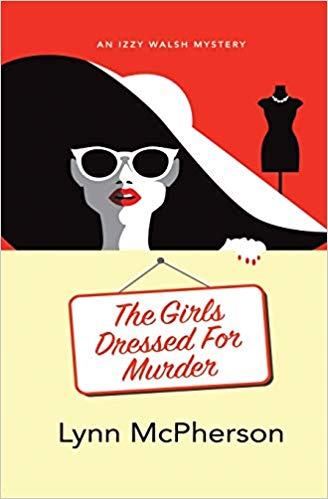
The Girls Dressed for Murder is a light-hearted, character-driven whodunit set along the New England coastline in the 1950’s. It is the third book in the Izzy Walsh Mystery Series and belongs to a sub-genre of crime fiction called Cozy Mystery. You may want to know the characteristics that define a cozy before choosing one for your book club. Let’s take a look.
First of all, the violence is done primarily off-stage. There are no gory details in any part of the novel—even the murder itself. In addition, cozy mysteries usually take place in a small town with an amateur sleuth as the protagonist. They are always whodunits and often incorporate a cast of recurring characters in an ongoing series. In The Girls Dressed For Murder, the central characters are all women who befriended one another during the Second World War while working in a munitions factory. Izzy Walsh relies heavily on the support and insight of her friends to help unravel the twisted truth in every case she stumbles upon.
Cozy mysteries are a lot of fun. You will shed no tears or experience any restless nights due to disturbing images. At the end of each book, justice has been served and order has been restored. While the books may be a part of a series, each one is a complete novel with no loose ends.
What makes a cozy mystery a great choice for a book club?
Like any novel, loads of research must be done to get it right. The Girls Dressed for Murder is set in 1958. The clothing, dialogue, cars, and setting were all carefully chosen. Pop culture is rarely the focus of history books, so a discussion of research is always fun. For example, some of the best insights I found were online in old magazines. Thanks to Google, every issue of LIFE magazine is archived. Both the articles and the advertisements were key to help me create the perfect fictional world for my books.
Let’s not forget the mystery. The best part of a cozy is trying to figure out who is the murderer. A cozy will keep you on your toes. Red herrings and real clues are sprinkled throughout the story—the reader must step into the detective’s shoes to figure out who to trust and where to look.
So what will you discuss at your next book club if you choose a cozy? Will it be the murder? The characters? The research? Any or all will guarantee an evening full of laughter and fun.
Lynn McPherson has worked for the Royal Canadian Mounted Police, ran a small business, and taught English across the globe. She has travelled the world solo, where her daring spirit has led her to jump out of airplanes, dive with sharks, and learn she would never master a surfboard. Lynn serves on the Crime Writers of Canada Board of Directors, currently representing Toronto and Southwestern Ontario, and is the author of the Izzy Walsh Mystery Series. Her latest book, The Girls Dressed For Murder, came out in August 2019.
My first novel The Work is about a woman who falls in love with the charismatic leader of a theatre group and stays with him for two decades, even though — at least on the surface of things — there’s not a lot in it for her. The question I get asked most often is whether it’s based on personal experience.
The answer is, yes and no.
Have I stayed fruitlessly loyal for years and years? Ooooooh yeah! And I wanted to get inside that experience in The Work. I have lived through a prolonged romantic obsession; I see these sorts of relationships around me all the time, but they’re not common in literature. They’re difficult to write about. I guess a short, self-destructive love affair provides a better story arc. Yet I’m fascinated with what makes a person stay and stay and stay … and stay. What is she getting out of it?
Rebecca, my protagonist, is competent — too competent at times — yet she falls prey to someone who manipulates and takes advantage of her. I tried to understand what, in her personality, might make her susceptible, but mostly I wanted to show that anyone is susceptible.
And what about the theatre group, SenseInSound, which functions on the borderline between therapy and self-expression, and has many cult-like qualities? I teach a form of movement (Feldenkrais Technique), which required a long, intensive training, and I’ve also participated in various of disciplines that unite body and mind. (And by the way, they’re almost always referred to as The Work.) In my PhD research I’m studying the history of physical culture in 19th and 20th century Europe, so I know the territory.
I have never had an experience where a leader or teacher abused their power — or not seriously — but I know it happens. And I absolutely see how it can. I drew from my own experiences then speculated … What if…? What if someone crossed the line right now?
But I didn’t want to make this aspect of the story cut-and-dried. I didn’t want to show a cult leader pulling people into his orbit and spitting them out as broken souls. People benefit from The Work, or at least, they find a way to present their experiences in a positive light. In the end, The Work is the main character in The Work. It’s beneficial in small doses, but when people entangle themselves with it too closely, it becomes harmful.
The theatre company spends a long time in process, continually reshaping its plays, building them, then tearing them down and rebuilding them again. These sections of my book almost wrote themselves, and I think that’s because I love process so much.
My fascination with process is the inspiration behind my reading series, Draft, which I founded in 2005 in the Leslieville area of Toronto. We invite both emerging and well-known authors to share their work-in-progress at the readings. Reading new work to a sympathetic audience can sometimes provide more ideas for revision than ten pages of comments. And for the audience, there’s something special about hearing work that is unfinished. It means that you are actually part of the author’s process. You’re part of the writing.
It took me a long time to write my novel — not because I was keeping some kind of noble distance until it was ready to be shared, but because I couldn’t seem to make The Work work. Of course I got impatient, because I kept running out of money and wanting to do other projects. From an artistic point of view, though, I enjoyed my long engagement with The Work. I prefer being in process to finishing a project. I could have kept on changing the book forever, but I knew it was time finally to polish it up and move on.
The Work is the first part of a trilogy, which moves backwards in time. It looks at The Work in different eras. One book takes place in England in the 1950s, and the other is divided between Berlin in the 1930s and 1980s California. These prequels show The Work not just in different, eras but in the hands of different practitioners, and they draw on the historical research I’ve been doing for my PhD. As a writer, I find this daunting project reassuring. It’s always good to know there’s plenty of Work on the horizon!
Maria is the author of The Work. Her first book, Outside the Box from McGill-Queen’s University Press, won the Alison Prentice Award for Women’s History. Her essays, fiction and poetry have appeared in many publications including The Literary Review of Canada, Descant and Musicworks, as well as in the anthologies, At the End of Life: True Stories About How We Die and The M Word: Conversations About Motherhood. She has made two radio series, Parent Care, and Remembering Polio for CBC Ideas.
From 1993 to 2010 she ran The Writing Space Press with Diana Kiesners. She was a member of the editorial board of Descant magazine from 1995 to 2001. In 2005, Maria founded the Draft Reading Series which specializes in unpublished work by emerging and established writers.
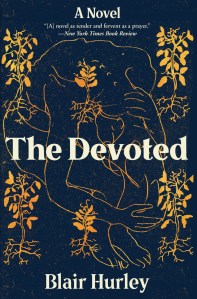
I wrote my first novel, The Devoted, while still living in my hometown of Boston, fresh out of a grad writing program and keen to tell a story that I felt passionate about. It took four or five years of struggling with scenes and characters and memories from my own childhood, but it didn’t really come together as a story until I realized that I had to step into risky, unknown territory, both from my own realm of experience and also beyond it.
The Devoted is inspired by both my Irish Catholic roots and my lifelong interest and research into Buddhism in America, particularly the experience of women exploring Buddhist practice. The novel is about a Boston Irish Catholic woman who, disillusioned by the sexual abuse scandals of the church that broke in the early 2000s, converts to Zen Buddhism. After heartbreak and betrayal, she becomes trapped in a manipulative sexual relationship with her Zen Master. The book raises the question of how the #metoo movement can play out in spiritual spaces, where powerful, respected teachers have abused their authority with vulnerable students seeking a spiritual experience. It also explores the healing and redemptive power that faith, both Catholic and Zen, can bring to our lives.
To write the novel, I had to immerse myself in research about both Catholicism and Zen, reading religious texts, but also Zen poetry, koans, and folktales from Buddhist cultures. I read the fascinating memoirs of medieval Buddhist nuns and was surprised to discover their honest, forthright discussions of the discrimination they encountered. In one Tibetan nun’s account, she sings mournfully of how her Master refuses to believe she can achieve the same level of spiritual accomplishment as the monks that surround her; she defiantly declares she will prove him wrong.
Many of my readers assume that I’m more familiar with the Catholic portions of the story, but even though my family has Irish Catholic history, I was raised without any particular religious affiliation, free to explore and visit religious spaces without any sort of official allegiance. To write my character’s strict Catholic upbringing, I had to dive deep into Catholic stories, songs, and doctrine, questioning my family about their own memories and jokes and superstitions. When writing scenes set both in Catholic churches and Buddhist Zendos, I felt as much of an outsider as my character, stepping tentatively inside the temple for the first time. What if I got some crucial points of doctrine or ritual wrong? What if I inadvertently disrespected someone else’s sacred space? For the early drafts of my writing, I hovered nervously on the edges of writing these scenes, afraid to offend or to misrepresent, afraid that I didn’t have what it took to write the scene authentically. Writers often struggle with this question of authenticity — do I dare tell this story? Is it my story to tell? Can I do this story justice?
For me, the line came when I realized I had written cautiously around the edges of the real issues I wanted to address. To really show my character’s experience on the page — with her family, with her Zen Master, singing in church and running away from it, fighting with her brother and falling in love and betraying people all on her messy quest for personal grace — I had to walk into those rooms with her. I had to do my homework, get the research right, walk into those spaces myself whenever I could, and in my imagination when I couldn’t. I visited Zen and Tibetan temples, and wandered in and out of Catholic churches; I read and listened; and at some point, when I had done the work, I had to sit down at my desk, take a deep breath, and begin.
Blair Hurley is the author of The Devoted published by W.W. Norton and Penguin Random House Canada. The novel was longlisted for The Center for Fiction’s First Novel Prize. Her work is published or forthcoming in Electric Literature, The Georgia Review, Ninth Letter, Guernica, Paris Review Daily, West Branch, and elsewhere. She received a 2018 Pushcart Prize and scholarships from Bread Loaf, Hawthornden Castle, and the Ontario Arts Council.
Use the Search Button (top right) to look up a book title, an author, location (e.g., Vancouver), or key words (e.g., thriller) or visit our Invite An Author page.
Visit our Invite An Author page to learn more about our amazing authors!













 The Authors Book Club